What Is the First Trimester for Pregnancy for the Baby
The First Trimester
What You Need to Know
- At your commencement prenatal visit, y'all will undergo a concrete exam also every bit sure tests and screenings to appraise the health of you and your unborn babe.
- First trimester symptoms vary from woman to woman, with some experiencing all known symptoms and others merely a few. Duration of symptoms can vary also.
- After eight weeks, the embryo is referred to as a fetus.
- Although the fetus is only 1 to 1.5 inches long at this point, all major organs and systems have been formed.
- During the outset trimester, the fetus is well-nigh susceptible to impairment from substances, like alcohol, drugs and certain medicines, and illnesses, like rubella (German measles).
Your First Prenatal Visit
Your commencement prenatal visit is the nigh thorough. A complete medical history is taken, a physical exam is done, and certain tests and procedures are performed to assess the health of both you and your unborn baby. Your first prenatal visit may include:
-
Personal medical history. This may include taking record of any of the following:
-
Previous and electric current medical conditions, like diabetes, high blood force per unit area (hypertension), anemia and/or allergies
-
Current medicines (prescription, over-the-counter and nutritional supplements)
-
Previous surgeries
-
-
Maternal and paternal family unit medical history, including illnesses, intellectual or developmental disabilities, and genetic disorders, similar sickle prison cell affliction or Tay-Sachs illness
-
Personal gynecological and obstetrical history, including by pregnancies (stillbirths, miscarriages, deliveries, terminations) and menstrual history (length and duration of menstrual periods)
-
Pedagogy, including a discussion regarding the importance of proper nutrition and expected weight gain in pregnancy; regular practice; the abstention of alcohol, drugs and tobacco during pregnancy; and a give-and-take of whatsoever concerns virtually domestic violence
-
Pelvic exam. This test may be done for one or all of the following reasons:
-
To notation the size and position of the uterus
-
To determine the age of the fetus
-
To bank check the pelvic bone size and structure
-
To perform a Pap test (also called Pap smear) to find the presence of abnormal cells
-
-
Lab tests, including the following:
-
Urine tests. These are done to screen for bacteria, glucose and protein.
-
Blood tests. These are washed to determine your blood type.
-
All meaning women are tested for the Rh factor during the early weeks of pregnancy. Rh incompatibility happens when the mother's claret is Rh-negative, the begetter's blood is Rh-positive and the fetus' blood is Rh-positive. The mother may make antibodies against the Rh-positive fetus, which may atomic number 82 to anemia in the fetus. Incompatibility problems are watched and appropriate medical treatment is bachelor to prevent the formation of Rh antibodies during pregnancy. At that place are also other blood antibodies that may cause problems in pregnancy that are screened for on the first visit.
-
-
-
Blood screening tests. These are done to observe diseases that could have an result on the pregnancy. Ane example is rubella, an infectious disease that is likewise called High german measles.
-
Genetic tests. These are done to discover inherited diseases, similar sickle cell disease and Tay-Sachs disease.
-
Other screening tests. These are performed to find infectious diseases, like sexually transmitted diseases and urinary tract infections.
The get-go prenatal visit is also an opportunity to ask any questions or hash out any concerns that you may take about your pregnancy.
The Starting time Trimester: What to Await
A healthy first trimester is crucial to the normal development of the fetus. You may not be showing much on the exterior yet, but on the inside, all of the major body organs and systems of the fetus are forming.
As the embryo implants itself into the uterine wall, several developments have place, including the formation of the:
-
Amniotic sac. A sac filled with amniotic fluid, called the amniotic sac, surrounds the fetus throughout the pregnancy. The amniotic fluid is liquid fabricated by the fetus and the amnion (the membrane that covers the fetal side of the placenta) that protects the fetus from injury. Information technology besides helps to regulate the temperature of the fetus.
-
Placenta. The placenta is an organ shaped like a flat cake that simply grows during pregnancy. Information technology attaches to the uterine wall with tiny projections called villi. Fetal blood vessels grow from the umbilical cord into these villi, exchanging nourishment and waste products with your blood. The fetal claret vessels are separated from your blood supply past a thin membrane.
-
Umbilical cord. The umbilical cord is a ropelike cord connecting the fetus to the placenta. The umbilical cord contains two arteries and a vein, which behave oxygen and nutrients to the fetus and waste material products away from the fetus.
Information technology is during this commencement trimester that the fetus is about susceptible to damage from substances, like alcohol, drugs and certain medicines, and illnesses, like rubella (German measles).
During the get-go trimester, your trunk and your baby'due south body are changing rapidly.

Johns Hopkins Infirmary Designated as Baby-Friendly
The Baby-Friendly Hospital Initiative, a global program launched by the World Wellness Organization and the United Nations Children's Fund, has designated The Johns Hopkins Hospital as Baby-Friendly. This designation is given to hospitals and birthing centers that offer an optimal level of intendance for infant feeding and female parent-baby bonding.
The First Trimester: Changes to Your Body
During pregnancy, many changes will happen to your body to assist nourish and protect your baby. Women experience these changes differently. Some symptoms of pregnancy continue for several weeks or months. Others are only experienced for a short fourth dimension. Some women experience many symptoms, and other women feel only a few or none at all. The post-obit is a list of changes and symptoms that may happen during the first trimester:
-
The mammary glands enlarge, causing the breasts to swell and become tender in preparation for chest-feeding. This is due to an increased amount of the hormones estrogen and progesterone. A supportive bra should be worn.
-
Your areolas (the pigmented areas around each chest's nipple) will overstate and darken. They may go covered with small, white bumps called Montgomery's tubercles (enlarged sweat glands).
-
Veins go more than noticeable on the surface of your breasts.
-
The uterus is growing and begins to press on your bladder. This causes y'all to need to urinate more than often.
-
Partly due to surges in hormones, you lot may experience mood swings like to premenstrual syndrome, a condition experienced by some women that is characterized past mood swings, irritability and other physical symptoms that happen presently earlier each menstrual menstruation.
-
Increased levels of hormones to sustain the pregnancy may cause "morning sickness," which causes nausea and sometimes airsickness. Notwithstanding, morn sickness does not necessarily happen just in the morning and rarely interferes with proper nutrition for the mother and her fetus.
-
Constipation may happen as the growing uterus presses on the rectum and intestines.
-
The muscular contractions in the intestines, which help to move food through the digestive tract, are slowed due to high levels of progesterone. This may, in turn, cause heartburn, indigestion, constipation and gas.
-
Dress may feel tighter around the breasts and waist, as the size of the tum begins to increase to suit the growing fetus.
-
You may experience extreme tiredness due to the physical and emotional demands of pregnancy.
-
Cardiac volume increases by almost 40 to 50 percent from the beginning to the finish of the pregnancy. This causes an increased cardiac output. An increased cardiac output may cause an increased pulse rate during pregnancy. The increase in blood book is needed for extra blood flow to the uterus.
The Showtime Trimester: Fetal Development
The virtually dramatic changes and development happen during the first trimester. During the kickoff viii weeks, a fetus is called an embryo. The embryo develops speedily and by the end of the first trimester, it becomes a fetus that is fully formed, weighing approximately 0.5 to 1 ounce and measuring, on average, iii to 4 inches in length.
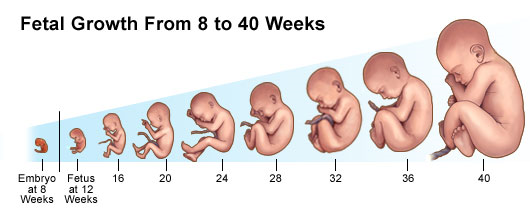
Starting time Trimester Fetal Growth and Evolution Benchmarks
The chart below provides benchmarks for almost normal pregnancies. However, each fetus develops differently.
| Timing | Development Benchmark |
|---|---|
| By the end of four weeks |
|
| By the end of viii weeks |
|
| From embryo to fetus |
|
| During weeks nine to 12 |
|
The fetus is most vulnerable during the get-go 12 weeks. During this period of time, all of the major organs and trunk systems are forming and can exist damaged if the fetus is exposed to drugs, infectious agents, radiation, certain medications, tobacco and toxic substances.
Even though the organs and body systems are fully formed past the end of 12 weeks, the fetus cannot survive independently.
Source: https://www.hopkinsmedicine.org/health/wellness-and-prevention/the-first-trimester
0 Response to "What Is the First Trimester for Pregnancy for the Baby"
Postar um comentário