what causes the earth to orbit the sun

Earth at seasonal points in its orbit (not to scale)
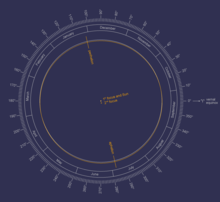
Earth orbit (yellow) compared to a circle (gray)
Earth orbits the Sun at an average distance of 149.60 million km (92.96 1000000 mi)[one] in a counterclockwise pattern viewed above the northern hemisphere. Ane complete orbit takes 365.256 days (ane sidereal yr), during which time Earth has traveled 940 million km (584 million mi).[ii] Ignoring the influence of other Solar System bodies, Earth'southward orbit is an ellipse with the Earth-Sun barycenter as 1 focus and a current eccentricity of 0.0167. Since this value is close to zip, the center of the orbit is relatively shut to the eye of the Sun (relative to the size of the orbit).
Every bit seen from Earth, the planet's orbital prograde motion makes the Sunday announced to move with respect to other stars at a rate of almost i° eastward per twenty-four hour period (or a Sun or Moon bore every 12 hours).[nb 1] World's orbital speed averages 29.78 km/s (107,208 km/h; 66,616 mph), which is fast enough to cover the planet's diameter in vii minutes and the distance to the Moon in 4 hours.[iii]
From a vantage bespeak to a higher place the north pole of either the Lord's day or Earth, Earth would appear to circumduct in a counterclockwise direction around the Sun. From the aforementioned vantage point, both the Earth and the Sun would appear to rotate besides in a counterclockwise management about their corresponding axes.
History of report [edit]

Heliocentric Solar Arrangement

Heliocentrism (lower panel) in comparison to the geocentric model (upper panel), non to calibration
Heliocentrism is the scientific model that first placed the Lord's day at the middle of the Solar System and put the planets, including Earth, in its orbit. Historically, heliocentrism is opposed to geocentrism, which placed the Earth at the eye. Aristarchus of Samos already proposed a heliocentric model in the third century BC. In the sixteenth century, Nicolaus Copernicus' De revolutionibus presented a full discussion of a heliocentric model of the universe [4] in much the same manner as Ptolemy had presented his geocentric model in the second century. This "Copernican revolution" resolved the upshot of planetary retrograde motion by arguing that such motion was simply perceived and apparent. Co-ordinate to historian Jerry Brotton, "Although Copernicus'southward groundbreaking volume ... had been [printed more than] a century earlier, [the Dutch mapmaker] Joan Blaeu was the first mapmaker to incorporate his revolutionary heliocentric theory into a map of the world."[v]
Influence on Earth [edit]
Because of Earth's centric tilt (often known as the obliquity of the ecliptic), the inclination of the Sun's trajectory in the sky (as seen past an observer on Earth's surface) varies over the grade of the year. For an observer at a northern breadth, when the northward pole is tilted toward the Sunday the day lasts longer and the Sun appears higher in the sky. This results in warmer average temperatures, as additional solar radiation reaches the surface. When the n pole is tilted abroad from the Sun, the reverse is true and the weather is mostly cooler. North of the Arctic Circumvolve and south of the Antarctic Circle, an extreme case is reached in which there is no daylight at all for function of the twelvemonth, and continuous daylight during the reverse time of year. This is called polar night and midnight sunday, respectively. This variation in the weather (because of the direction of the Earth's centric tilt) results in the seasons.[half-dozen]
Events in the orbit [edit]
By astronomical convention, the four seasons are adamant by the solstices (the two points in the Earth's orbit of the maximum tilt of the Earth's axis, toward the Sun or abroad from the Dominicus) and the equinoxes (the two points in the Earth's orbit where the World'due south tilted axis and an imaginary line fatigued from the World to the Dominicus are exactly perpendicular to one another). The solstices and equinoxes divide the year up into iv approximately equal parts. In the northern hemisphere winter solstice occurs on or about December 21; summer solstice is near June 21; spring equinox is around March 20, and autumnal equinox is well-nigh September 23.[7] The effect of the Earth'south axial tilt in the southern hemisphere is the reverse of that in the northern hemisphere, thus the seasons of the solstices and equinoxes in the southern hemisphere are the reverse of those in the northern hemisphere (e.g. the northern summer solstice is at the same time equally the southern winter solstice).
In modern times, World'southward perihelion occurs effectually January iii, and the aphelion around July 4. In other words, the Globe is closer to the Sun in January, and further away in July, which might seem counter-intuitive to those residing in the northern hemisphere, where it is colder when the World is closest to the sunday and warmer when it is furthest abroad. The changing Globe-Sun distance results in an increase of nigh vii% in full solar energy reaching the Earth at perihelion relative to aphelion.[8] Since the southern hemisphere is tilted toward the Sunday at almost the same fourth dimension that the Globe reaches the closest approach to the Sun, the southern hemisphere receives slightly more energy from the Sun than does the northern over the course of a year. However, this effect is much less significant than the total free energy modify due to the centric tilt, and most of the excess energy is absorbed by the college proportion of surface covered by water in the southern hemisphere.[9]
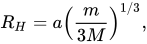
The Hill sphere (gravitational sphere of influence) of the Earth is near 1,500,000 kilometers (0.01 AU) in radius, or approximately four times the average distance to the Moon.[x] [nb 2] This is the maximal distance at which the Earth'due south gravitational influence is stronger than the more distant Sunday and planets. Objects orbiting the Earth must exist inside this radius, otherwise, they may get unbound by the gravitational perturbation of the Sun.
| epoch | J2000.0[nb 3] |
| aphelion | 152.x×ten 1.0167 AU[nb four] |
| perihelion | 147.10×x 0.98329 AU[nb 4] |
| semimajor centrality | 149.60×ten 1.000001018 AU[xi] |
| eccentricity | 0.0167086[11] |
| inclination | 7.155° to Sunday's equator 1.578690°[12] to invariable aeroplane |
| longitude of the ascending node | 174.nine°[11] |
| longitude of perihelion | 102.9°[11] |
| argument of periapsis | 288.1°[11] [nb 5] |
| flow | 365.256363 004 days[13] |
| average orbital speed | 29.78 km/s (18.50 mi/s)[3] 107,208 km/h (66,616 mph) |
| speed at aphelion | 29.29 km/due south (18.20 mi/s)[3] |
| speed at perihelion | 30.29 km/s (eighteen.82 mi/s)[3] |
The following diagram shows the relation between the line of the solstice and the line of apsides of Earth's elliptical orbit. The orbital ellipse goes through each of the six World images, which are sequentially the perihelion (periapsis—nearest point to the Sun) on anywhere from January 2 to Jan 5, the point of March equinox on March 19, twenty, or 21, the point of June solstice on June 20, 21, or 22, the aphelion (apoapsis—the farthest indicate from the Sunday) on anywhere from July 3 to July five, the September equinox on September 22, 23, or 24, and the December solstice on December 21, 22, or 23.[seven] The diagram shows a very exaggerated shape of Earth's orbit; the actual orbit is virtually round.

Time to come [edit]
Mathematicians and astronomers (such as Laplace, Lagrange, Gauss, Poincaré, Kolmogorov, Vladimir Arnold, and Jürgen Moser) have searched for evidence for the stability of the planetary motions, and this quest led to many mathematical developments and several successive "proofs" of stability for the Solar System.[fourteen] Past most predictions, Earth's orbit will be relatively stable over long periods.[15]
In 1989, Jacques Laskar's piece of work indicated that Earth'south orbit (equally well every bit the orbits of all the inner planets) can get chaotic and that an error equally small equally 15 meters in measuring the initial position of the Earth today would make it impossible to predict where Globe would be in its orbit in just over 100 million years' time.[xvi] Modeling the Solar System is a bailiwick covered by the n-body trouble.
See besides [edit]
- Globe phase
- Earth's rotation
- Spaceship Earth
Notes [edit]
- ^ Our planet takes about 365 days to orbit the Dominicus. A full orbit has 360°. That fact demonstrates that each day, the World travels roughly 1° in its orbit. Thus, the Sun will appear to move across the sky relative to the stars past that same amount.
- ^ For the Earth, the Loma radius is
- ^ All astronomical quantities vary, both secularly and periodically. The quantities given are the values at the instant J2000.0 of the secular variation, ignoring all periodic variations.
- ^ a b aphelion = a × (1 + east); perihelion = a × (ane – e), where a is the semi-major axis and eastward is the eccentricity.
- ^ The reference lists the longitude of perihelion, which is the sum of the longitude of the ascending node and the argument of perihelion. Subtracting from that (102.937°) the node longitude of 174.873° gives −71.936°. Adding 360° gives 288.064°. That addition does not change the angle but expresses information technology in the usual 0–360° range for longitudes.

References [edit]
- ^ "Sun: Facts & Figures". Solar System Exploration. National Helmsmanship and Infinite Administration. Archived from the original on July 3, 2015. Retrieved July 29, 2015.
- ^ Jean Meeus, Astronomical Algorithms 2nd ed, ISBN 0-943396-61-1 (Richmond, VA: Willmann-Bell, 1998) 238. Meet Ellipse#Circumference. The formula by Ramanujan is accurate enough.[ citation needed ]
- ^ a b c d Williams, David R. (1 September 2004). "World Fact Canvas". NASA. Retrieved 17 March 2007.
- ^ De revolutionibus orbium coelestium. Johannes Petreius. 1543.
- ^ Jerry Brotton, A History of the World in Twelve Maps, London: Allen Lane, 2012, ISBN 9781846140990 p. 262.
- ^ "What causes the seasons? (NASA)". Retrieved 22 January 2015.
- ^ a b "Date & Fourth dimension of Solstices & Equinoxes". 28 August 2013. Retrieved 22 January 2015.
- ^ "Solar Energy Reaching The Earth's Surface". ITACA. Retrieved xxx January 2022.
- ^ Williams, Jack (20 December 2005). "Earth's tilt creates seasons". USAToday. Retrieved 17 March 2007.
- ^ Vázquez, M.; Montañés Rodríguez, P.; Palle, E. (2006). "The Globe equally an Object of Astrophysical Involvement in the Search for Extrasolar Planets" (PDF). Instituto de Astrofísica de Canarias. Retrieved 21 March 2007.
- ^ a b c d e Simon, J.L.; Bretagnon, P.; Chapront, J.; Chapront-Touzé, M.; Francou, Grand.; Laskar, J. (February 1994). "Numerical expressions for precession formulae and mean elements for the Moon and planets". Astronomy and Astrophysics. 282 (ii): 663–683. Bibcode:1994A&A...282..663S.
- ^ Allen, Clabon Walter; Cox, Arthur N. (2000). Allen'south Astrophysical Quantities. Springer. p. 294. ISBN0-387-98746-0.
- ^ The figure appears in multiple references, and is derived from the VSOP87 elements from department 5.eight.iii, p. 675 of the post-obit: Simon, J. 50.; Bretagnon, P.; Chapront, J.; Chapront-Touzé, Thou.; Francou, Grand.; Laskar, J. (February 1994). "Numerical expressions for precession formulae and mean elements for the Moon and planets". Astronomy and Astrophysics. 282 (ii): 663–683. Bibcode:1994A&A...282..663S.
- ^ Laskar, J. (2001). "Solar System: Stability". In Murdin, Paul (ed.). Encyclopedia of Astronomy and Astropvhysics. Bristol: Institute of Physics Publishing. article 2198.
- ^ Gribbin, John (2004). Deep simplicity : bringing order to anarchy and complexity (1st U.S. ed.). New York: Random House. ISBN978-1-4000-6256-0.
- ^ "Earth-Venus blast-up possible". xi June 2009. Archived from the original on 23 January 2015. Retrieved 22 January 2015.
External links [edit]
- World – Speed through space – almost 1 million miles an hour – NASA & (WP discussion)
Source: https://en.wikipedia.org/wiki/Earth%27s_orbit
0 Response to "what causes the earth to orbit the sun"
Postar um comentário