When a Cold Front Passes, the Lowest Pressure Reading at a Station Will Occur
A cold front is the leading edge of a cooler mass of air at ground level that replaces a warmer mass of air and lies within a pronounced surface trough of low pressure level. It often forms behind an extratropical cyclone (to the west in the Northern Hemisphere, to the e in the Southern), at the leading border of its cold air advection blueprint—known as the cyclone's dry "conveyor belt" menstruum. Temperature differences across the boundary can exceed 30 °C (54 °F) from ane side to the other. When enough moisture is present, rain can occur along the purlieus. If there is significant instability along the boundary, a narrow line of thunderstorms can form along the frontal zone. If instability is weak, a wide shield of rain can motility in behind the front, and evaporative cooling of the rain can increase the temperature difference beyond the front. Cold fronts are stronger in the autumn and spring transition seasons and weakest during the summer.

The symbol of a cold front: a bluish line with triangles pointing in the management of travel
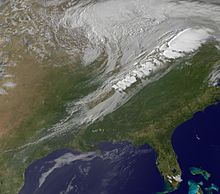
A cold front end over the eastern and central region of the U.s.
Development of cold fronts [edit]
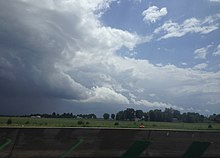
An incoming cold front end in northern Ohio (2016)
A common cold front occurs when a mass of insufficiently colder air moves into where warmer air is present. The drier, colder air forms a steeply sloping boundary nether the warmer, moister air at the surface and lifts that air. This oftentimes causes deject formations with strong vertical development, which may manifest as a line of showers and thunderstorms when enough wet is present.[1] On weather maps, the surface position of the common cold forepart is marked with the symbol of a blue line of triangles/spikes (pips) pointing in the direction of travel. A common cold front's location is at the leading edge of the temperature drop off, which in an isotherm assay would evidence upward as the leading border of the isotherm slope, and it normally lies within a sharp surface trough.[ii] Cold fronts move faster than warm fronts and can produce sharper changes in conditions. Since cold air is denser than warm air, it rapidly replaces the warm air preceding the boundary.[3]
In the northern hemisphere, a cold forepart usually causes a shift of wind from southwest to northwest clockwise, besides known equally veering, and in the southern hemisphere a shift from northwest to southwest (counterclockwise, backing). Atmospheric pressure steadily decreases with the approach of a cold front; with frontal passage, the pressure rises sharply and then stabilizes. Normally, cold fronts tin be marked by these characteristics:[4] [ane]
| Weather condition phenomenon | Prior to the passing of the front end | While the front is passing | After the passing of the front |
|---|---|---|---|
| Temperature | Warm | Cooling suddenly | Steadily cooling |
| Atmospheric pressure | Decreasing steadily | Lowest, and so sudden increase | Increasing steadily |
| Winds |
| Gusty; shifting |
|
| Precipitation/conditions* | Light patchy rain can be produced by stratocumulus or stratus in the warm sector. In summer, sometimes thunderstorms if a preceding squall line is nowadays. In winter snow squalls or showers may occur.[v] | Prolonged rain (nimbostratus) or thunderstorms (cumulonimbus): depends on conditions. | Showers, and so clearing |
| Clouds* | Often preceded by cirrus, cirrostratus and then altostratus similar a warm front (but usually with smaller amounts of these clouds). Areas of cirrocumulus and altocumulus within cirrostratus and altostratus more than unremarkably seen than at a warm front. Larger cumulus clouds under the college deject types than at a warm forepart, where stratocumulus and cumulus humilis usually occur. Some of these cumulus clouds may produce showers ahead of the front end. | Cumulonimbus and cumulus congestus producing frequent showers, with a sheet of upper altostratus, through which the lord's day tin sometimes be seen. Less commonly nimbostratus occurs with continuous rain. | Patchy altocumulus or stratocumulus and higher cirrus clouds along with fast moving stratus fractus then eventually scattered cumulus and sometimes cumulonimbus. |
| Visibility* | Fair to poor in haze | Poor, just improving | Good, except in showers |
| Dew Point | High, steady | Sudden drop | Falling |
*provided there is sufficient moisture.

Stratocumulus clouds later on a cold forepart
Clouds [edit]

Altocumulus clouds oftentimes are a sign of an entering cold front.
If the cold front is highly unstable, cumulonimbus clouds producing thunderstorms usually form along the front. Anvil cirrus clouds may spread a considerable distance downwind from the thunderstorms.[6] The other deject types associated with a common cold front depend on atmospheric conditions such equally air mass stability and wind shear.[7] As the forepart approaches, eye-étage gives style to altostratus and low-level stratocumulus with intermittent light precipitation if the warm airmass being displaced by the cold front is mostly stable. With significant airmass instability, vertically developed cumulus or cumulonimbus with showers and thunderstorms will form along the front end.
Later the passage of the cold front, the sky normally clears as high pressure level builds in behind the system, although pregnant amounts of cumulus or stratocumulus, often in the form of long bands called deject streets may persist if the air mass behind the front remains humid.[8] Small and unchanging amounts of cumulus or cirrus clouds in an otherwise clear sky are ordinarily indications of standing fair atmospheric condition every bit long every bit the barometric pressure remains comparatively high.
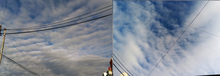
Altocumulus undulatus clouds several hours after a common cold front
Precipitation [edit]

A cold front every bit it appeared on the National Conditions Service Wichita, Kansas WSR-88D on April iii, 2011. The sparse blue line labeled "cold front" is the front, with severe thunderstorms seen developing backside the front, which is moving towards the lesser right.
A cold front commonly brings a narrow band of precipitation that follows along the leading border of the cold front. These bands of atmospheric precipitation are often very strong,[9] and can bring astringent thunderstorms, hailstorms,[10] snow squalls,[v] and/or tornadoes. In the spring, these common cold fronts tin can be very strong, and can bring strong winds when the pressure gradient is college than normal. During the wintertime months, cold fronts sometimes come through an expanse with lilliputian or no atmospheric precipitation. Wider pelting bands can occur behind common cold fronts which tend to have more stratiform, and less convective, precipitation.[eleven] These rainstorms sometimes bring flooding, and can motion very slowly when the tempest steering information technology is strong and embedded inside a meridional menses blueprint (with more pole to equator move rather than west to east motion). In the winter, cold fronts can bring cold spells, and occasionally snow. In the spring or summer in temperate latitudes, hail may occasionally fall forth with the rain. If moisture is not sufficient, such as when a system has previously moved across a mount barrier, cold fronts can pass without cloudiness.
Frontogenetical circulation [edit]
Frontogenesis is the process of creating or steepening the temperature gradient of a front end. During this process the atmosphere reacts in an endeavor to restore residuum, the event is a circular motion forth the forepart where air is being lifted up, along the cold forepart and dropping downwardly, backside the frontal boundary. This is the bodily force of upward move forth a front that is responsible for clouds and precipitation.
As the temperature slope steepens during frontogenesis, the thermal current of air becomes imbalanced. To maintain remainder, the geostrophic wind aloft and beneath conform, such that regions of divergence/convergence form. Mass continuity would require a vertical transport of air forth the cold front where in that location is divergence (lowered pressure level). Although this circulation is described by a series of processes, they are really occurring at the same fourth dimension, appreciable along the front as a thermally direct circulation. There are several factors that influence the concluding shape and tilt of the circulation around the forepart, ultimately determining the kind and location of clouds and precipitation.[vii] [12]
Temperature changes [edit]
Cold fronts are the leading border of cooler air masses, hence the proper noun "common cold front". They have stronger temperature changes during the fall (fall) and jump and during the eye of winter. Temperature changes associated with cold fronts can be every bit much as thirty °C (54 °F). When cold fronts come up through, there is usually a quick, yet potent gust of wind, that shows that the cold front is passing. In surface weather observations, a remark known as FROPA is coded when this occurs.[13] The furnishings from a cold front can final from hours to days. The air behind the front is cooler than the air it is replacing and the warm air is forced to rise, so it cools. As the cooler air cannot agree as much moisture every bit warm air, clouds grade and rain occurs.[four]
[edit]
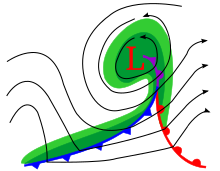
Occluded whirlwind instance. The triple point is the intersection of the cold, warm, and occluded fronts.
Cold fronts course when a libation air mass moves into an surface area of warmer air in the wake of a developing extratropical whirlwind. The warmer air interacts with the cooler air mass along the boundary, and usually produces precipitation. Cold fronts frequently follow a warm front or squall line. Very unremarkably, cold fronts have a warm front end ahead simply with a perpendicular orientation. In areas where cold fronts catch up to the warm front end, the occluded front develops. Occluded fronts have an area of warm air aloft. When such a feature forms poleward of an extratropical whirlwind, it is known as a trowal, which is short for TRough Of Warm Air aFiftyoft.[14] A cold front is considered a warm front if it begins to retreat alee of the next extratropical whirlwind along the frontal boundary, and called a stationary front if it stalls.
Encounter also [edit]
- Air mass
- Blue Norther (atmospheric condition)
- Cold wave
- Surface atmospheric condition assay
- Weather front
References [edit]
- ^ a b Whiteman, C. David (2000). Mountain meteorology : fundamentals and applications. New York: Oxford University Press. pp. 77–79. ISBN978-0-nineteen-803044-7. OCLC 428735924.
- ^ David Roth (2006-12-xiv). "Unified Surface Analysis Manual" (PDF). Hydrometeorological Prediction Centre. Retrieved 2012-01-09 .
- ^ Paul M. Markowski; Yvette P. Richardson (2011-09-20). Mesoscale Meteorology in Midlatitudes. John Wiley and Sons. p. 120. ISBN978-ane-119-96667-eight . Retrieved 2012-01-09 .
- ^ a b "Common cold Front: transition zone from warm air to common cold air". ww2010.atmos.uiuc.edu . Retrieved 2019-xi-09 .
- ^ a b Donald, Ahrens, C. (2007). Meteorology today : an introduction to conditions, climate, and the environment (8th ed.). Belmont, Calif.: Thomson/Brooks/Cole. pp. 298–300. ISBN978-0495011620. OCLC 66911677.
- ^ Lee M. Grenci; Jon M. Nese (2001). A World of Weather condition: Fundamentals of Meteorology: A Text / Laboratory Manual (3rd ed.). Kendall/Hunt Publishing Company. pp. 207–212. ISBN978-0-7872-7716-i. OCLC 51160155.
- ^ a b Holton, James R. (2004). An Introduction to Dynamic Meteorology. Academic Printing. p. 277. ISBN978-0-12-354015-7.
- ^ Weston, K. J. (1980). "An observational study of convective cloud streets". Tellus. 32 (v): 433–438. Bibcode:1980TellA..32..433W. doi:10.1111/j.2153-3490.1980.tb00970.ten.
- ^ Glossary of Meteorology (2009). Prefrontal squall line. Archived 2007-08-17 at the Wayback Machine Retrieved on 2008-12-24.
- ^ Schemm, S.; 50. Nisi, A. Martinov; D. Leuenberg & O. Martius (2016). "On the link between cold fronts and hail in Switzerland". Atmospheric Science Letters. 17 (v): 315–325. Bibcode:2016AtScL..17..315S. doi:ten.1002/asl.660.
- ^ K. A. Browning and Robert J. Gurney (1999). Global Energy and Water Cycles. Retrieved on 2008-12-26.
- ^ Carlson, Toby Northward. (1991). Mid-latitude Atmospheric condition Systems. HarperCollins Academic. p. 435. ISBN978-0-04-551115-0.
- ^ Nav Canada (January 2005). Aviation Weather Services Guide. p. 36.
- ^ St. Louis University (2003-08-04). "What is a TROWAL? via the Internet Wayback Machine". Archived from the original on 2006-09-16. Retrieved 2006-xi-02 .
External links [edit]
- Cold Forepart: transition zone from warm air to cold air
- Conditions Fronts
- Fronts: the boundaries between air masses
Source: https://en.wikipedia.org/wiki/Cold_front
0 Response to "When a Cold Front Passes, the Lowest Pressure Reading at a Station Will Occur"
Postar um comentário